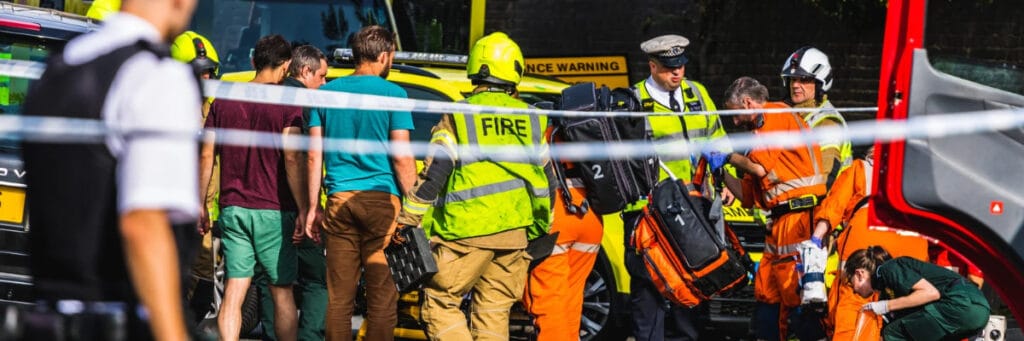
First Responders Therapy consists of trauma-informed mental health support for police officers, firefighters, paramedics, correctional officers, dispatchers and their families, from therapists who understand the job firsthand.
First responders repeatedly face situations most people encounter only once or twice in a lifetime. You train to run toward emergencies and become experts at assessing, acting, and managing them. You make split-second decisions in life-or-death situations, and your training requires you to do all of this while staying composed.
Traumatic events form the basis of your job; however, you must also process the trauma. Many training programs either ignore this second part or address it only superficially. In 2018, the Canadian Journal of Psychiatry reported Canadian research involving 5,813 public safety personnel, where 44.5% screened positive for symptoms consistent with at least one mental health disorder.
First Responders Therapy – Compounding Trauma
Traumatic events affect everyone, and sometimes, one impactful incident is enough to stop a first responder in their tracks. More commonly, however, trauma builds quietly, compounding each time you witness death, violence, serious injury and human distress. Your nervous system tracks it all, even those events you don’t consciously remember. Over time, the compounding unprocessed trauma shows up as:
- Irritability, anger or a shorter fuse at home;
- Emotional numbness or feeling disconnected from the people you love;
- Hypervigilance and difficulty relaxing off duty;
- Nightmares, poor sleep or intrusive memories;
- Avoiding places or conversations that remind you of the trauma;
- Using alcohol or substances to unwind or numb your angst;
- Pulling away from family and friends
These signal that your nervous system is struggling to process the load you are carrying and that you need support. If your symptoms last for more than one month and severely disrupt daily life, you should get assessed for Post-traumatic stress disorder (PTSD), a mental health condition that develops after a person experiences a terrifying, dangerous, or life-threatening event.
Why First Responders Are at Greater Risk
Unlike the rest of the population, the impact of compounding trauma gets layered on top of personal and workplace pressures for first responders. You experience disrupted sleep from shift work, are expected to suppress personal feelings while on the job and work in a culture that discourages asking for help.
Your training teaches you to compartmentalize your emotions, a valuable skill that allows you to get the job done without distraction. However, that same skill forces you to avoid heavy emotions that your nervous system needs you to process. You may even believe that vulnerable thoughts and feelings make you less capable of doing your job.
This is exactly what traps first responders, placing you at a greater risk of succumbing to unhealthy behaviour patterns, anxiety and depression, PTSD and other mental health problems.
PTSD and Moral Injury
PTSD can leave you asking, “Am I really safe?” Moral injury can leave you asking, “Am I still the person I believed I was?”
Moral injury can happen when you act, witness and even avoid situations that violate your value system, the deeply held sense of right and wrong. Your work puts you at the forefront of both hapless and hopeless situations; you might have to choose the lesser of two bad options, leaving people to suffer regardless of your decisions. The impact can leave you questioning your own identity and include immense guilt, shame and anger. For many first responders, the hardest part isn’t just the calls. It’s the organizational stress, the decisions made above them, and the feeling of not being supported afterward.
How Therapy Can Help
Overworking, withdrawing, intense exercise, and consuming alcohol and intoxicants may take the edge off temporarily, but these are avoidance behaviours. They don’t let your nervous system work through trauma. A therapist trained in first responder therapy can help you to address both the fear-based responses of trauma and the deeper questions of meaning, values and trust that moral injury raises.
This type of dedicated first responder therapy can help you:
- Make sense of specific critical incidents and the cumulative weight of years on the job;
- Reduce nightmares, hypervigilance, intrusive memories and sleep problems;
- Work through guilt, shame and anger connected to moral injury;
- Reconnect with your partner, kids and friends, and be present when you’re home;
- Build practical coping strategies that fit shift work and the realities of your profession.
Relationship with Your Therapist
The relationship you build with your therapist matters more than any single therapeutic technique. Research shows that this therapeutic alliance is one of the strongest predictors of positive outcomes in psychotherapy. It stems from trust, emotional safety and feeling truly understood. This shapes every facet of your healing.
For first responders, it holds even more true. Building this relationship with a therapist and developing coping strategies early can make riding out hard calls or a getting through a tough year much easier. You shouldn’t have to reach a breaking point to recognize that you need support. The healthiest decision a new recruit could make is to start therapy early in your career, and integrate it on an ongoing basis as an aspect of your career management, well before the struggles arrive.
First Responders Therapy at Shanti
At Shanti Psychotherapy, we use evidence-based, trauma-informed modalities such as EMDR, CBT, DBR and many other approaches, which your therapist will tailor to match your needs. We work with:
- Police officers and special constables
- Firefighters
- Paramedics and EMS personnel
- Correctional officers
- 911 dispatchers and communicators
- Veterans
- Spouses, partners and families of first responders
Trauma doesn’t stay at the call. It comes home and affects marriages, intimacy, parenting and friendships. Often the people closest to you notice the change before you do, which is why we support families too.
Effective first responder therapy requires a therapist to have solid understanding of your work culture: the dark humour that helps crews cope, the pressures of working within a chain of command, the stigma that makes emotional struggles a weakness, and the fear that asking for help could affect your career advancement or fitness for duty.
Furthermore, bearing it out in the open to someone who may not “get it” is a huge deterrent that keep many from seeking first responders therapy. We match you with therapists who thoroughly understand your job or have experienced being first responders, themselves.
Contacting Us for First Responder Therapy
If you are struggling with some of the issues described here, please contact us. If you suspect someone in the first responder community requires mental health support, consider forwarding this page link to them. The first assessment with one of our trained intake counsellors is free and confidential.


If you are in crisis or thinking about suicide, call or text 9-8-8 (Suicide Crisis Helpline, available 24/7 across Canada) or call 911.
Frequently Asked Questions about First Responder Therapy
FAQ’s About First Responders Therapy
What you share in therapy is confidential, with limited legal exceptions. We review these in your first session, so you know exactly where the boundaries are.
No. You can come in if you’re not sleeping, you’re short with your family, or you just don’t feel like yourself. We encourage first responders who are just starting out to seek first responder therapy as a way to prepare you psychologically to face dangerous and perilous situations that inevitably will become part of your job, before they start impacting your mental health and your personal and professional life.
Our professional designations are recognized by insurance plans, and many first responders receive coverage through workplace extended health benefits, employee assistance programs, or WSIB
That’s okay. You set the pace. Many people start by focusing on sleep, stress or relationships before ever discussing a particular incident.